
The Ultimate 2025 Sofa Configuration Guide
Get your free copy todayy!
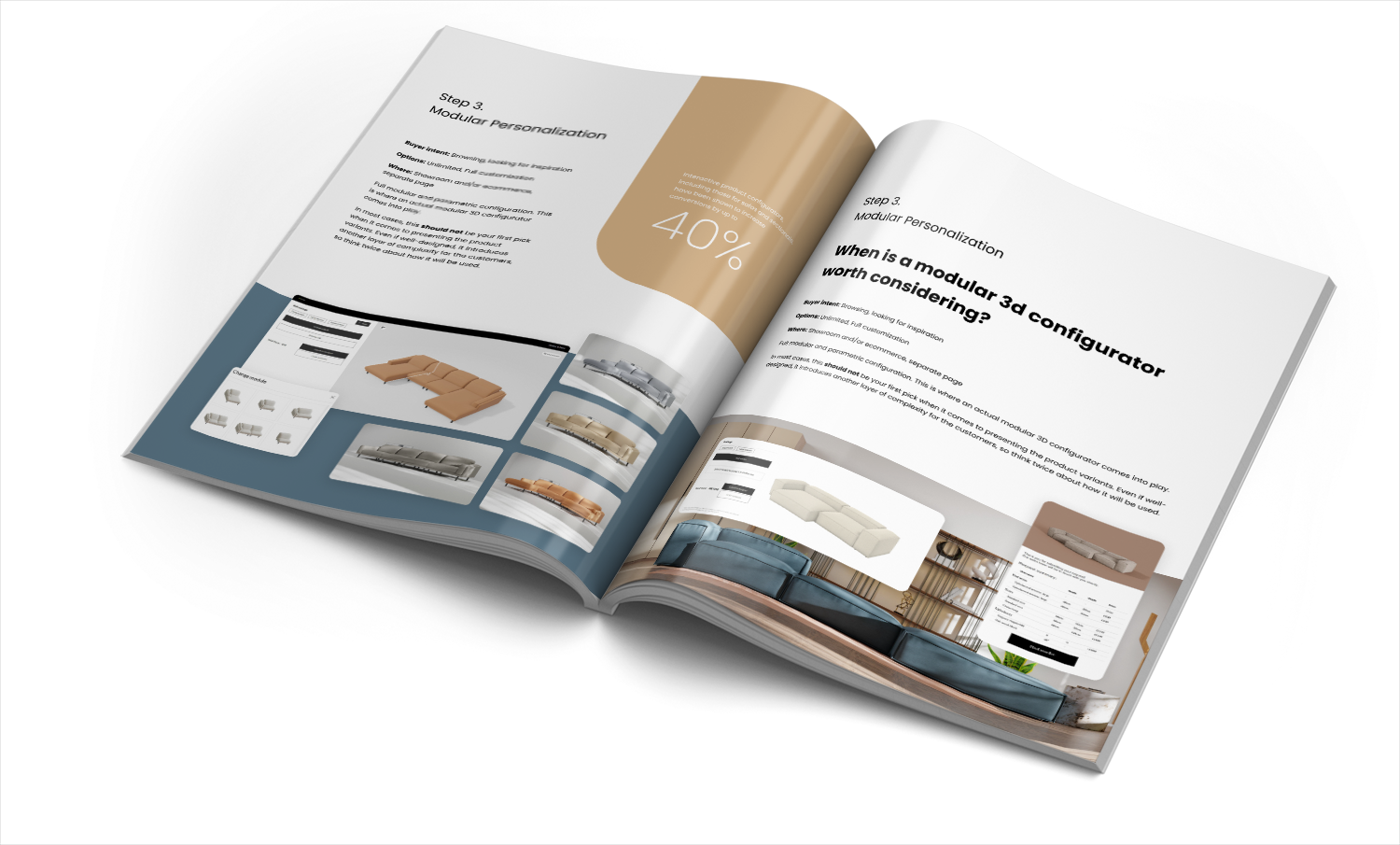
I often hear brand owners say the same thing: “Every order is personal. We always talk to the customer anyway.” That used to be enough. But lately, something changed. Buyers now expect to understand their options before they ever reach out. They want to see scale, shape, finish, a ballpark price-and most of all, what’s actually possible-right away.
A furniture product configurator answers that expectation. It helps when conversation no longer covers all those bases quickly enough. I’ve seen sales teams lose weeks quoting the same table in three sizes and five finishes. That isn’t personal service. That’s repetition.
A configurator is not a digital fad. It’s a response to buying friction. It brings clarity where imagination fails. This article looks at when a furniture configurator genuinely helps, and when it adds nothing but complexity to your process. I’m not talking about technical setup. I’m talking about commercial logic and fit-where visual clarity becomes a real sales advantage.
In furniture sales, people rarely hesitate because they dislike talking to you. They hesitate because they can’t picture what they’re buying. Size, finish, proportion-all abstract until made visible. Buyers want certainty before committing, especially when price tags stretch into the thousands.
I’ve seen this pattern across dozens of brands. The issue isn’t personalization-it’s visualization friction. Sales teams waste time sending the same reference photos or sketching quick drawings to explain small differences. That’s when a 3D furniture configurator shows its worth. It turns abstract choices into clear, buildable visuals.
Data from our internal research backs that up. When people can explore finishes and dimensions visually, engagement rises sharply. Decision times shrink. Returns drop. The logic is simple: showing creates confidence. And confidence shortens cycles.
When those visuals come directly from production rules, errors disappear before they even start. Each valid combination becomes both a quote and a guarantee that the product can be built exactly as shown.
A custom furniture configurator only works when your products follow repeatable rules. Think of shared base frames with variable legs, tops, or finishes. A single sofa design available in multiple fabrics. A cabinet built from fixed modules in different widths. That’s where a configurator thrives-it enforces logic and keeps every combination realistic.
It stops making sense when each piece is a unique artwork. If there are no shared rules, there’s nothing to automate. I’ve seen workshops try to upload one-off designs into configurator software just to look “modern.” It never ends well. Maintenance becomes heavier than just quoting manually.
Configurators support decision-making. They don’t replace design talent or artistic dialogue. Instead of imagining them as design tools, see them as clear, rule-based maps of what’s already possible.
If your offer has too much variability but no structure, you first need structure. Once you have defined options, then configuration can come in. It’s like teaching the system the grammar of your collection before expecting it to form correct sentences.
To understand where your products stand on that scale, read our internal perspective on Personalization Strategy: Three Levels of Furniture Product Personalization. It breaks down how far you can go before technology adds friction instead of clarity.
This is where the logic meets vislas. A furniture product configurator creates measurable value when specific conditions are met. I usually look for these signals:
When those signs appear, a configurator saves time, reduces miscommunication, and scales without additional staff. Take a look at the Paradise Grills case study. After implementing a real-time configurator with AR visualization, connected with their custom POS system, they saw a massive 15% increase in showroom sales. Customers stopped guessing. They started buying.
Behind any of these cases sits strong furniture configurator software tied into pricing and manufacturing logic. Without that alignment, the technology alone doesn’t produce the same impact.
If you’re evaluating your own readiness, our Parametric 3D Product Configurator outlines how visual rules connect to live pricing, ERP, and CRM. It’s the same backbone that makes configuration reliable rather than decorative.
Not every business needs one. Sometimes, adding a furniture configurator serves only to complicate a straightforward process. Here’s when I advise brands to hold off:
Our internal data shows something many overlook: a bad configurator damages credibility. When visuals mislead, returns rise and production waste grows. That’s worse than saying nothing. That’s why any custom furniture configurator must be governed by correct product data and realistic visuals.
Businesses without repeatable product structures should first document their internal rules manually. Only then does technology make sense. Until then, even a simple photo gallery serves better.
In the end, a furniture product configurator succeeds when it frees your teams from explaining the same things again and again. It shortens cycles not by forcing self-service, but by making the conversation more concrete.
The failures usually come from imitation. Many brands add a configurator simply because a competitor has one. They forget to check whether they have the product logic to support it. The result is an underused tool that looks advanced but solves no real problem.
The smarter alternative is slower: first, map what’s repeatable in your collection. Then decide what visual clarity would genuinely help customers commit faster. Only then bring in configuration.
So here’s the question I leave brand owners with: Where in your current sales process are you explaining the same thing again and again? That’s usually where configuration belongs.


.jpg)
.jpg)
.jpg)
