
The Ultimate 2025 Sofa Configuration Guide
Get your free copy todayy!
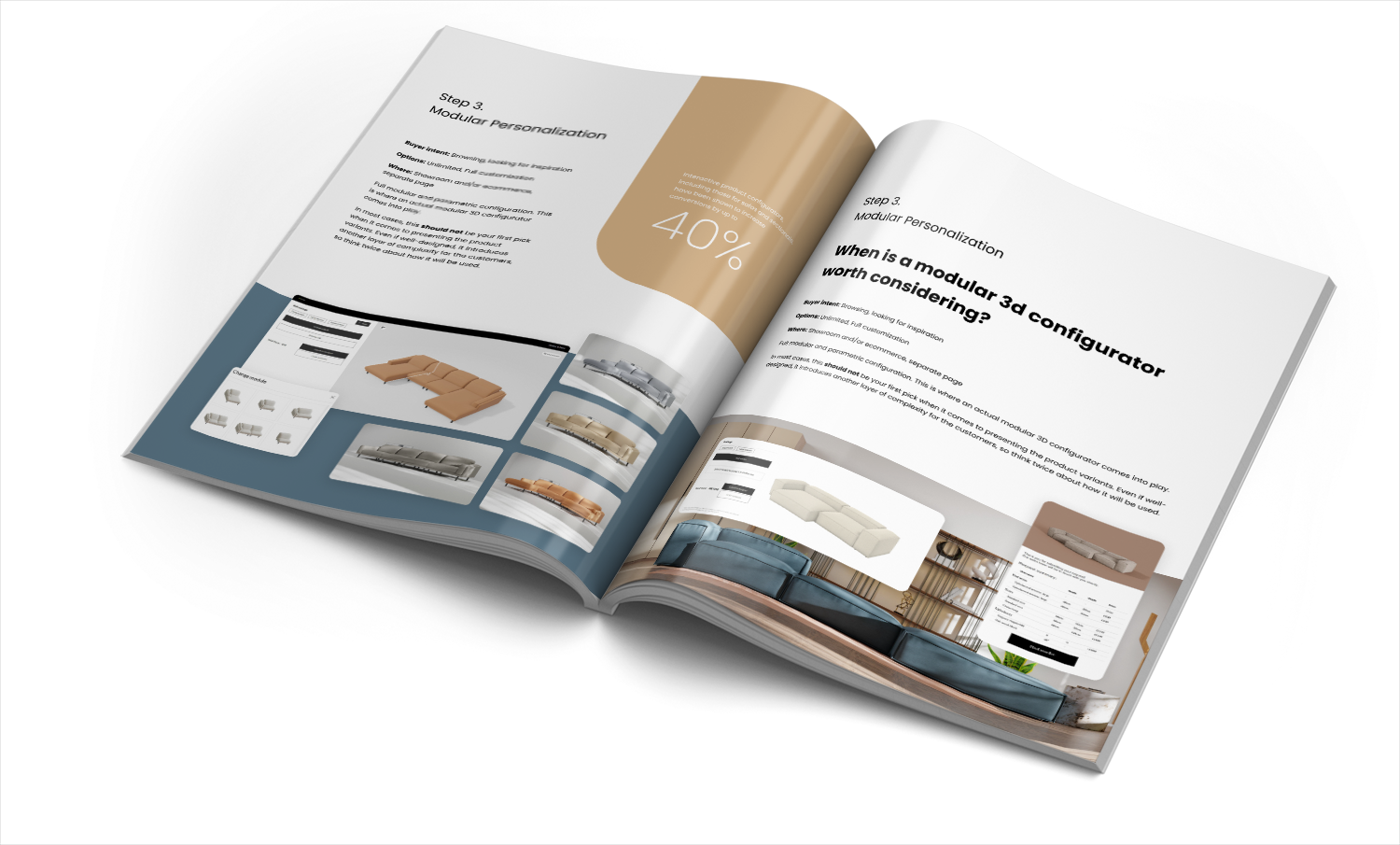
A few months ago, at the 4DesignDays trade fair in Poland, I met the owner of a hardwood furniture company. Beautiful pieces. Handcrafted. Solid as they come. After a friendly chat, I asked him a simple question: do you have a configurator? He looked puzzled and said, “What’s that?”
That moment stuck with me. I spend my days talking about digital tools, automation, and online selling. But not everyone lives in that bubble. Many independent furniture makers still focus on craft and tradition-and rightly so. So this short piece is for them.
If you sell customized furniture, especially handcrafted tables, sofas, or shelving, you’ve probably heard of product configurators in passing. Let me explain what a furniture configurator really is, how it fits your kind of business, when it helps, and when it doesn’t.
I often hear brand owners say, “Every order is personal. We always talk to the customer anyway.” That’s true, but lately, something changed. Buyers now expect to understand their options before contacting you. They want to see scale, shape, finish, ballpark price and - most of all what’s actually possible - right away.
A furniture configurator helps when conversations alone are no longer enough. Customers hesitate when they can’t picture what they’re buying. They send endless emails asking about combinations, pricing, or delivery time. I’ve seen brands lose weeks to quote the same table in three sizes and five finishes.
A configurator prevents that. It presents choice in a clear, visual way. It shows customers what’s possible without repeating yourself. Even for handcrafted furniture, that transparency builds confidence and shortens the buying cycle.
A furniture configurator is more than a 3D viewer. It’s a structured decision-support tool built around three parts:
But here’s the key: a configurator is not a gallery or a toy. It doesn’t replace your craftsmanship. It complements it. It helps clients make confident choices before they talk to you. For high-end furniture, that means fewer misunderstandings, fewer wrong orders, and smoother collaboration.
People often ask me, “But our furniture is always unique - how would that work?” The answer lies in structure.
Configurators thrive when your products share a repeatable base structure, even if the outcomes are unique. Imagine tables where customers can choose:
The logic remains the same for each table. The details vary. The same applies to sofas-fabric, layout, arm shape, and legs all follow rules.
A 3D furniture configurator lets customers visualize these variables, then locks invalid options. It helps them see proportions and textures. It saves you from guessing what they mean by “lighter oak” or “slightly thinner legs.” Tools like photorealistic 3D or optional AR placement make the decision more tangible.
A good case is what we did with Modern Shelving’s 3D Configurator for Shelving System. Their products are modular, not mass-produced. Yet the configurator helped cut quoting time from hours to minutes. That principle works just as well for artisan-made tables as it does for shelving.
Let’s be honest: not every product benefits. Here’s how I evaluate it with clients.
If you’re unsure, check our guide When a Furniture Product Configurator Helps and When it Doesn’t. It breaks down typical decision factors and real-world examples.
A configurator is most useful when structure repeats and customers hesitate. It’s rarely about automating art (having said that, Ar-range.app has a great solution for showcasing art in AR!); it’s about reducing friction in business. Cost and complexity should follow that same line of thought.
Every year, I see brands rush into configurators because they look impressive. But… let me share what usually goes wrong-and what works better.
We followed those principles while developing our Parametric 3D Product Configurator. It connects visualization and real-time data with backend systems so the same configuration feeds pricing, order, and production. That’s how handcrafted and digital workflows finally meet.
To refine how many options to offer, see our piece on Personalization Strategy - The 3 Levels of Product Customization. It’s an important read before deciding exactly how your configurator should behave.
A furniture configurator is not about speed or automation; it’s about clarity, accuracy, and trust. It removes uncertainty for customers and noise for you. If your pieces are unique in outcome but repeatable in structure, it might be time to turn that craftsmanship into a guided digital experience.


.jpg)
.jpg)
.jpg)
