
The Ultimate 2025 Sofa Configuration Guide
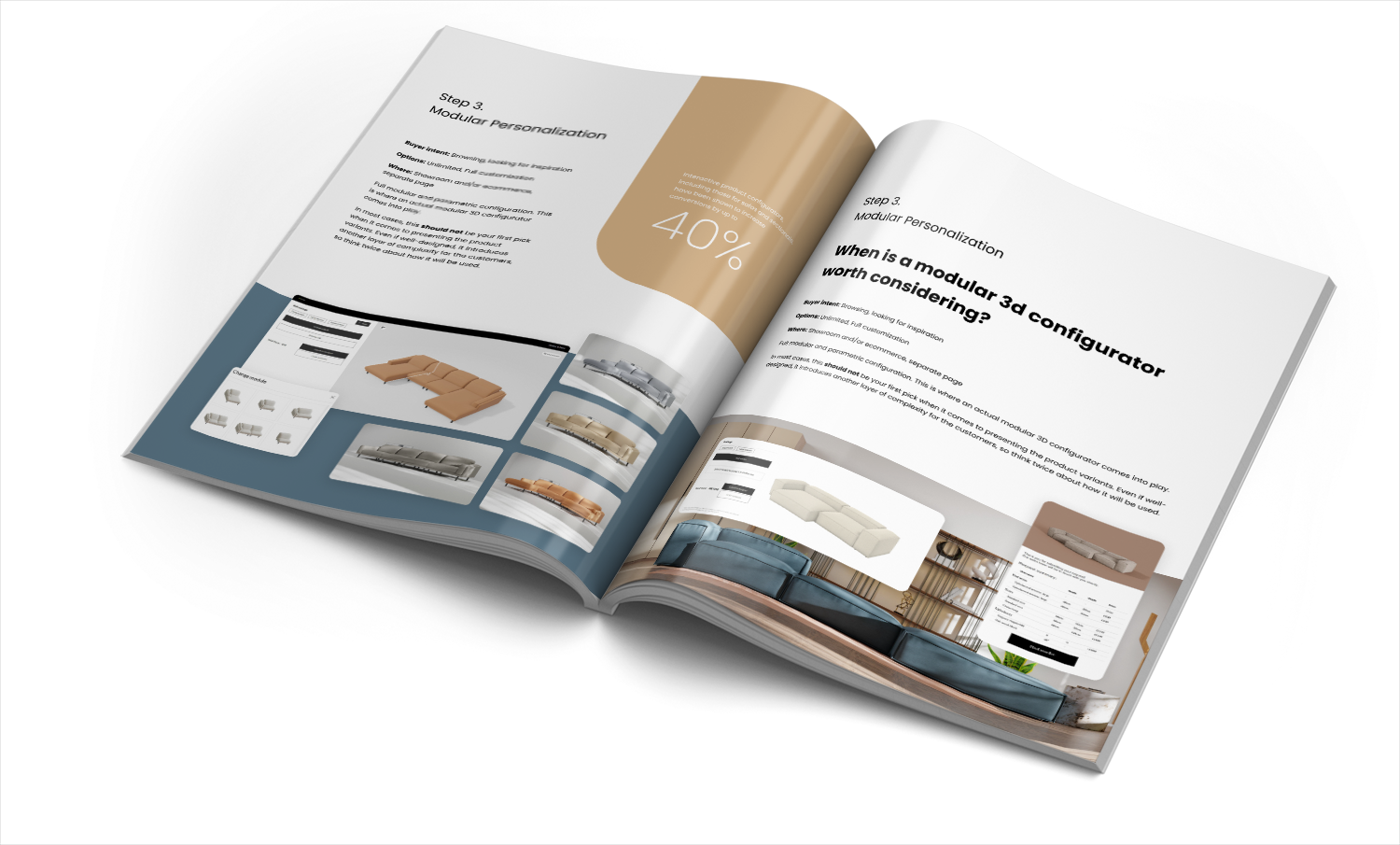
Get your free copy todayy!
Every few weeks, someone asks me the same thing: Can I build a product configurator without 3D models? The thought comes naturally. 3D sounds expensive. Photos already exist. AI seems magical. So the idea of a product configurator without 3D models feels tempting - quick, light, and cheaper. I understand that impulse. But what you’re really asking is how far you can go before the system cracks.
When we talk about a configurator built without 3D models, we mean one driven by photos, 2D layers, or AI‑generated images instead of any geometrical model. It’s still a visual product configurator, but the engine under the hood changes. And like any engine, it behaves differently once you push it beyond a certain speed.
In short: yes, you can launch a product configurator without 3D. But it will hold only as long as your catalog is small, your rules are simple, and you’re ready for a lot of manual correction.
The typical argument for a non‑3D product configurator starts the same way: “We already have thousands of product photos.” Or: “AI can generate anything now.” Then there’s the classic: “3D is only for complex furniture.” I’ve heard these lines in more meetings than I can count.
The assumption hiding behind them is that a configurator is just a camera. But it’s not. It’s a logic machine pretending to be a gallery. A working configurator needs the picture to follow rules. The logic defines what can and cannot be combined. Visuals come second.
Photo‑based product configurators were the starting point of the industry. You take one picture per finish and swap layers manually - the Photoshop era of digital retail. Some brands even built large systems around this. But then variants grew. Lights changed between photo shoots. Angles drifted. That’s when these systems began to crumble.
Manual QA replaced automation. One wrong reflection meant reshooting entire sets. Eventually, the logic failed to keep visuals aligned. What once looked simple turned into chaos.
Our article on configurator types, shows this exact curve - from small, controllable setups to unmanageable complexity. The pattern is the same everywhere: non‑3D is fine until it grows.
When a buyer plays with a configurator, their mind doesn’t chase realism. It chases consistency. Does the color look the same on the sofa and on the armchair? Does fabric A stay fabric A when shown with different lighting? If yes, trust builds. If not, doubt enters.
That’s why scalable product configurators depend on logical consistency more than polished visuals. In a 3D vs non‑3D configurator comparison, this becomes clear: image‑based configurators rely on pictures staying aligned, while 3D ones rely on mathematical rules. One breaks when humans get tired. The other doesn’t.
In our projects, we’ve seen a direct chain between visual consistency and commercial outcomes. The clearer the visual logic, the fewer support calls, fewer errors, fewer returns. That’s why 3D wins not on beauty, but on reliability.
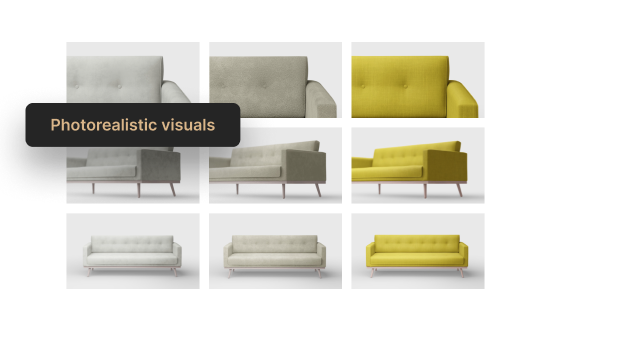
Some brands still operate effectively with 2D methods. A photo‑based product configurator or a 2D configurator uses layers stacked through if/then logic. Pick a color, swap a layer. Pick a fabric, change a texture. It’s clean when the range is small.
It can work for cushions, simple tables, or decorative pieces. But stretch that model across modular systems, or items with dozens of parts, and complexity explodes. Angles stop matching. Shadow consistency disappears. Every week, small fixes pile up. The photo‑based method that looked clever becomes costly to maintain.
That’s where tools like Automated Product Visuals help. Automation can partially offset the manual labor of layering and color logic. But - we need 3d models for that.
AI‑generated visuals as a partial solution
AI is the new puzzle piece. Teams now build AI product configurator images almost as experiments. The results are impressive when you view one image at a time. Models like Nano Banana Pro can manipulate texture and lighting convincingly. The problem starts once you check ten variations in a row.
Fabric tones shift slightly. The same sofa material looks cooler on one photo, warmer on another. Multiply that by hundreds of products and you face a coordination nightmare. Human review becomes mandatory, not optional.
Consistency review itself becomes an overhead cost. Each visual must be checked individually and also in relation to the whole catalog. When you include that work, the savings vanish.
I often hear that AI is cheaper. That’s half true. For a few hundred renders, yes. But once you pass a few thousand - it flips. In a recent project where we generated more than two million visuals for a major bed manufacturer, each AI image ended up costing more than a traditional 3D render. The 3D vs non‑3D configurator debate closed itself. 3D delivered predictable timing, uniform lighting, and no revision loops.
Interestingly, AI still has a meaningful role. It shines in storytelling - generating lifestyle shots, contextual images for social posts, or personalized backgrounds. We’ll explore this hybrid use in more detail soon. It mirrors how our Augmented Reality Viewer helps clients show products in realistic rooms, anchoring the configurator in the customer’s space instead of replacing it.
The decision point doesn’t arrive with technology but with scale. When you begin managing hundreds of customization combinations, a visual framework built on photos or AI starts breaking apart.
Here’s what I often see:
A good decision framework looks simpler:
Use non‑3D if:
Go for 3D if:
If that’s your world, a scalable product configurator must start with geometry. And that’s where our Custom 3D Product Configurator shows why 3D remains the core visual foundation for furniture product configurators. It’s not about cinematic realism. It’s about predictable logic, cost control, and trust.
Non‑3D methods still have their place. They’re brilliant for MVP launches, simple products, and fast portfolio tests. Adding AI or AR, in moderation, can make them even more engaging. But over the years, every brand that grows inevitably moves toward 3D - not because it’s trendy, but because it’s stable.
Before deciding, look at your catalog and ask yourself three questions:
That’s where the real answer hides. Not in pixels, but in predictability.
For further reading on approaches and technology trade‑offs, check How to Pick the Best Product Configurator (With Real Examples). It showcases several operational models that reflect exactly these patterns.
Because in the end, a configurator isn’t about what tool you choose. It’s about how calmly, and how predictably, your visuals can grow with your business.




.jpg)
.jpg)
.jpg)
