The talk: new technologies in the furniture industry
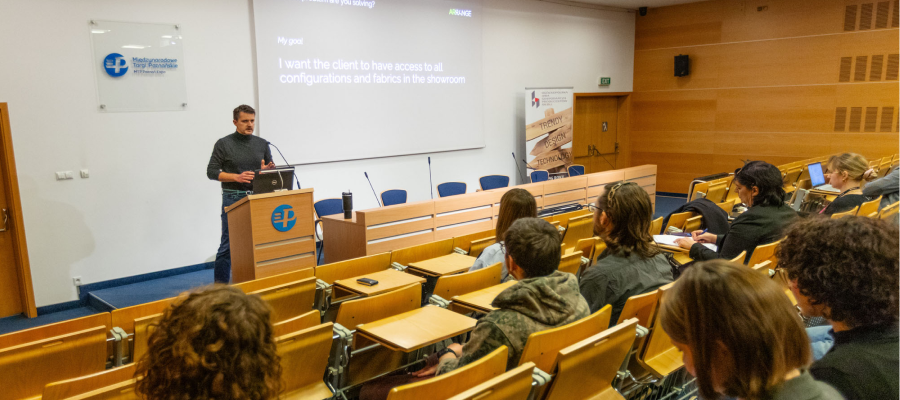
As announced in Interior Daily in January, Marcin Stempniewicz, CEO of Ar-range, spoke at Meble Polska on 27 February at 11:15 on whether tools like 3D configurators, AR and AI actually improve results, or only mask deeper problems in a company’s processes and market strategy.
The talk covered three questions: when is the right time to implement a configurator, why is it worth it, and where is the balance between automation and personalisation. The argument was that a configurator is worth building when it removes a measured cost, most often the hours a designer or salesperson spends turning one customer’s wishes into a quote, and not worth building because a competitor has one.
Marcin walked through one implementation from the first brief to the finished integration. It started with the business need written as a question: how long does personalising one order take today, and what should it take? Changes then shipped in short iterations against real orders, and the last step was the software itself and its connection to the manufacturer’s website. The outcomes he showed were measured against that first question: the time per personalised order, the number of enquiries, and how the designers’ hours were spent afterwards.
Four questions came out of it for anyone weighing a configurator:
- How much time does your team spend on product personalisation today, per order?
- What problem should the configurator solve? One problem, stated in a sentence.
- Does offering more options lead to a better sale, or only to a longer decision?
- Do you want software you own, or a licence you renew?
What the audience asked
Three questions from the floor stayed with us, so here they are with the answers.
When does automation really pay off? When the thing you automate is already costing you hours you can count. Take the time one personalised quote takes today, multiply by the quotes you send in a month, and that is the ceiling of what a configurator can give back, before the orders that only happen because the customer could see the piece. If the product has three options and a price list, the arithmetic does not close. If a designer spends the afternoon on a single sofa layout, it closes quickly.
Can AI support the sale of custom products? Yes, where it helps a customer find and describe, and no, where it invents. Searching a catalogue of hundreds of fabrics by a spoken description works today and sells in a store. A sofa rendered from a sentence is a demo until the factory can make what the picture shows. The configurator is what keeps the AI honest: it only offers combinations that can be built and priced.
Does a configurator for glass interior products make sense? It does, and it is a different configurator. Partitions, shower enclosures and glass doors are defined by dimensions and a few finishes, so the value is a parametric one: the price from the measurements, the production drawing, and a quote the customer can carry away, with the 3D picture in a supporting role. The furniture configurator lives on the visual; the glass one lives on the numbers.
 Photo: Piotr Piosik, Grupa MTP
On the fair floor
The conversations we had were with manufacturers from several countries, and two topics kept returning. The first was how to get a showroom and a factory working from the same configuration, so the piece a customer builds in the store is the piece that goes into production. The second was what a configurator costs to keep alive after launch, when the next collection arrives.
The fair itself was large, with exhibitors looking for new markets and new ways to sell, and traditional sales next to digital ones on the same stands. The booths we remember best were Wersal, Forte and Befame.
 Photo: Piotr Piosik, Grupa MTP